
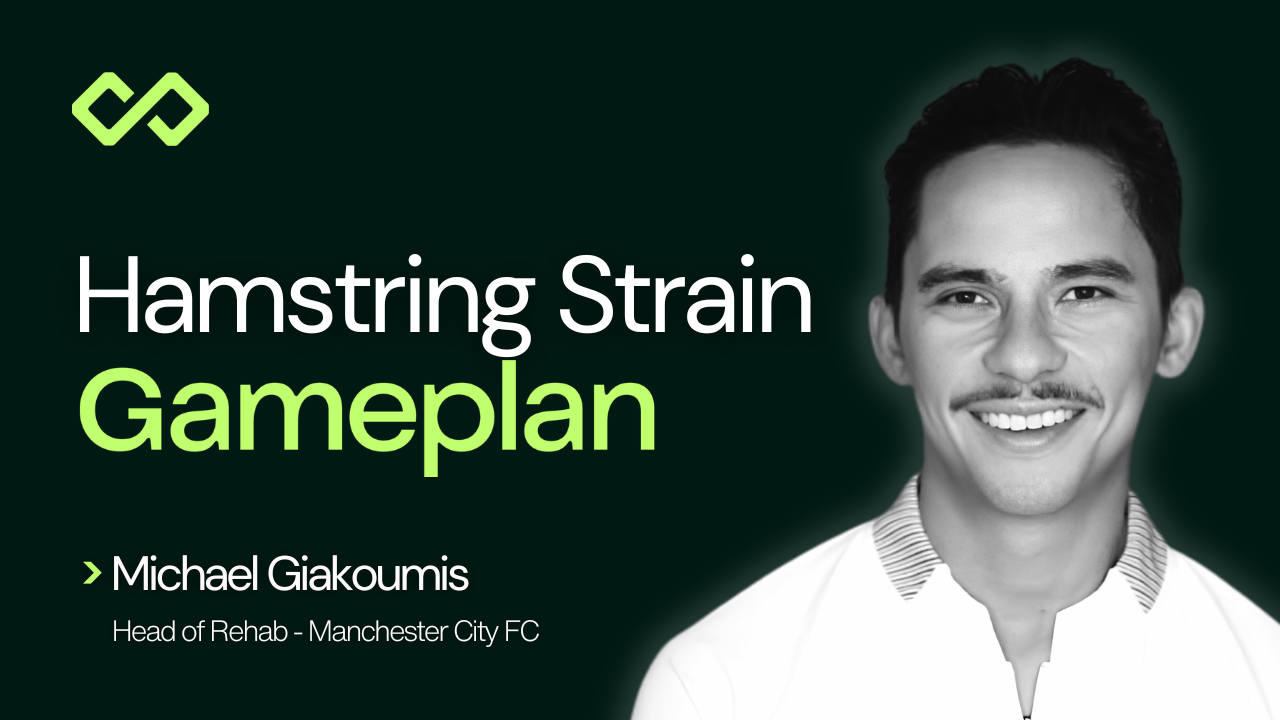
Episode 223: In this 1st episode of Gameplans — a collaboration between Gameplan and Inform Performance, Host Andy McDonald is joined by Michael Giakoumis, the Head of Rehab at Manchester City FC.
Michael is an experienced sports physiotherapist with specialised expertise in complex hip, groin, and lower-limb muscle injuries, frequently providing second opinions for challenging cases. He has previously held roles at the Marylebone Health Group in their specialist hip, groin, and muscle injury clinic, as well as within elite international athletics with British Athletics and across multiple other sports.
During the episode, Michael Giakoumis shares his comprehensive framework for hamstring rehabilitation, emphasising the importance of understanding sport demands, individual variability, and systematic planning for effective recovery.
Begin With the End: A Framework for Hamstring Rehabilitation in Football
The question most practitioners ask after a hamstring injury is: what do I do next?
The better question is: what does this athlete have to be capable of doing, and at what level?
That distinction sounds subtle. In practice, it changes everything about how the rehabilitation is designed, sequenced, and evaluated. Michael Giakoumis, Head of Rehab at Manchester City FC and one of the most experienced muscle injury specialists in elite football, structures his entire approach around this inversion. Start with the end. Build backwards. Then, and only then, fill in the methods.
What follows is a breakdown of that framework, from deconstructing sport demands through to the specific physical standards he applies at each stage, and how diagnosis shapes the pace of progression throughout.
The North Star: Three Layers of Demand
Before any exercise is selected, any criterion set, or any timeline proposed, the rehabilitation needs a precise target. Not a population average. A specific, layered picture of what this individual athlete, in this position, for this team, must be capable of doing.
Giakoumis describes three levels of demand that define that picture.
The first is the game. Total volume of high-speed running, sprint distance, number of accelerations, and the density of peak actions within compressed timeframes. These macro numbers set the ceiling. But he goes one level deeper: what are the peak demands within a one or two-minute window? And beyond the physical, what are the technical and tactical actions within those windows? A player who presses relentlessly in short bursts creates a different metabolic demand than one who holds position and accelerates in behind. Both cover similar ground. The mechanical output is not the same.
The second is the task within the game. Giakoumis uses the example of Messi playing as a number nine versus a centre forward who stretches the defensive line with repeated runs. Same position, entirely different hamstring demands. The same logic applies to a right back who overlaps and a right back who tucks in. Understanding how the athlete actually moves within a game, and how the injury mechanism maps onto those movements, adds the specificity that generic position-based planning cannot.
The third is the individual in front of you. Speed profile, anthropometry, playing style, injury history, even tibial morphology. Giakoumis notes that tibial varum, for example, can increase the mechanical demand on the hamstring during the stance phase of running. A previous ACL reconstruction using a semitendinosus graft changes the local anatomy and may require the rehabilitation targets to be elevated to compensate for what has been lost. The framework stays consistent. What changes is the application.
Coactives: Multiple Workflows, Running in Parallel
Rehabilitation does not move through discrete phases in sequence. It runs several workflows simultaneously, each with its own physical qualities, objectives, and criteria.
Giakoumis uses the term coactives deliberately. There is a local tissue stream addressing the hamstring. A return-to-run stream structured around progressive speed bands. A kinetic chain stream targeting the calf, knee, and hip musculature that supports running mechanics. A movement quality layer. A conditioning stream, managed largely off-feet in early phases. And underneath those, secondary workflows addressing contributing factors: trunk capacity, previous injury sites, anything identified at the outset as likely to influence the outcome.
The practical implication is that a rehab plan needs to account for all of these things simultaneously, not revisit them when a previous phase is deemed complete. Rehab, he says, is never linear. A system that treats it as linear is already behind.
Within running mechanics specifically, he draws on the two primary phases of the stride cycle: stance and swing. Different muscle groups dominate each. The quads and calves drive vertical force into the ground during stance. The hip musculature governs stride frequency during swing. As running speed increases above 7 m/s, stride frequency becomes the primary driver of velocity. The hip-based work needs to be in progress well before that threshold is reached, not introduced at it.
Physical Qualities and How They Sequence
Within the local tissue stream, Giakoumis works through six physical qualities: activation, muscular endurance, force production, tensile capability (force at length), rate of force development, and coordination, both locally around the hamstring and across the kinetic chain.
These are not phases. They overlap and blend, and the injury itself determines where you start.
The early constraint is inhibition. Post-injury, the nervous system limits what the tissue is willing to produce. Activation work is not remedial, it is a practical response to that inhibition. He notes that in some cases, inhibition resolves within days, not weeks. Electromyographic assessment can confirm this directly rather than defaulting to a fixed timeline. Once activation is restored, the emphasis shifts toward muscular endurance: lower force, higher volume, building the capacity to repeat efforts over time.
Force production, tensile capability, and rate of force development are layered in progressively. The athlete cannot start loading heavily at end-range on day two. The tissue will not tolerate it, and the injury constrains the starting point whether the practitioner acknowledges it or not. But the sequencing within those later qualities is not fixed either. An athlete whose primary deficit is concentric and isometric strength needs a different emphasis from one whose eccentric qualities are strong but whose endurance capacity has been significantly eroded. The framework provides the structure. The individual determines the emphasis within it.
Return to Run: Why Speed Bands Beat Percentages
The return-to-run phase is organised around four speed thresholds: approximately 3.5, 5, 7, and 9 metres per second. Each threshold represents a meaningful step-change in mechanical demand on the hamstring, and each acts as a gate for the physical quality criteria applied before progression occurs.
The rationale for using absolute speed bands, rather than percentage-of-maximum-velocity targets, is grounded in biomechanical fairness. At 70% of maximum velocity, an athlete capable of 10.5 m/s is running at nearly 7.4 m/s. An athlete capable of 8 m/s is running at 5.6 m/s. The hamstring demand at those two speeds is not equivalent. A percentage-based protocol applies the same criterion to two very different mechanical loads. The faster athlete is penalised for being fast, required to demonstrate physical capacity at much higher absolute loads before the same criterion is satisfied. Speed banding removes that inequity. The same band means the same demand.
The Physical Standards at Each Band
Giakoumis draws on McNally's 2023 systematic review and meta-analysis synthesising the biomechanical demands of running across increasing speeds, expressed in relative torque: newton metres per kilogram of bodyweight, enabling consistent comparison across athletes of different sizes.
At 3.5 m/s, the peak isometric hamstring demand is approximately 0.5 Nm/kg. In absolute terms, around ten kilograms. The demand at this speed is low enough that running can begin relatively early in most cases once clinical criteria are met. The position in which isometric testing is conducted at this stage reflects the need to protect the tissue at length: inner-range testing is the early standard, progressing as capacity improves.
At 5 m/s, the target rises to approximately 1.0 Nm/kg. At 7 m/s, 1.8 Nm/kg. At 9 m/s, 2.3 to 2.5 Nm/kg. Eccentric and tensile end-stage targets, referenced against the demands of maximal sprinting, sit at approximately 2.7 Nm/kg.
For muscular endurance, the standard is single-leg hamstring bridges performed at a one-second-up, one-second-down cadence. The minimum return-to-play standard is 30 repetitions. The ideal is 35. These targets are not applied only at the end of rehabilitation. Giakoumis stages them: he might want 20 to 25 bridges by the time 5 m/s running is being introduced, with the full standard achieved before higher-speed work begins.
Rate of force development is currently assessed via limb symmetry rather than against absolute normative values, because Giakoumis is direct about the fact that the published evidence is not yet sufficient to prescribe a specific RFD percentage at a defined time window. Near-symmetry between limbs is the working expectation by 7 m/s. Full symmetry is expected before 9 m/s running is introduced.
Beyond the hamstring, the kinetic chain benchmarks are as follows. Isometric calf strength in a straight-knee position: approximately 3.5 times bodyweight. Isometric squat or leg press at the knee: approximately 4 times bodyweight. And crucially, the relationship between those numbers matters as much as the numbers themselves. An athlete producing 5 times bodyweight at the knee and 3 times bodyweight at the calf carries a gap that Giakoumis considers a concern, even though the individual values appear strong. Balance across joints is not a soft preference. It reflects a real biomechanical exposure during the contact phase of running.
How Diagnosis Changes the Pace of Progression
The speed band framework provides consistent criteria across all hamstring injuries. What changes between injury types is how quickly running is initiated and how cautiously early progressions are managed.
Lower-grade and myofascial injuries, using the British Athletics classification developed by Pollock and colleagues, can generally tolerate earlier and more aggressive return to running. Giakoumis acknowledges that practitioners differ on this, and that individual clinical experience shapes comfort levels. Some have been cautious for good reason. But his position is that within the constraints of appropriate symptom management, earlier running in these cases is defensible and often advantageous.
Distal hamstring injuries and T-junction injuries warrant a different approach. The T-junction refers to the region where the long and short heads of the biceps femoris meet. Work by Fervrable, Cronin, and Entwistle has shown that this area experiences disproportionately high mechanical demand during the stance phase of running. As the short head lengthens, the long head remains comparatively stable, creating differential loading at the junction. This demand is present even at low running speeds. Giakoumis's response is deliberate: he delays return to running by several days for these specific injuries, not as blanket conservatism, but because the biomechanical rationale is clear and the cost of getting it wrong is high.
Criteria-Informed, Not Criteria-Led
The standards described above are not pass-or-fail gates. They are reference points that inform decisions, and the weight placed on any individual criterion depends on the context in which the decision is being made.
Giakoumis makes a distinction he considers important: criteria-informed versus criteria-led decision making. In a Champions League final, with a first-time low-grade injury and four days of preparation, the team may proceed on a symptom-led basis. If the athlete can sprint without pain, that becomes the primary driver. The physical quality targets provide a supporting frame, but no one is waiting for a 30-bridge standard to be met before a semi-final. That context has been acknowledged explicitly, the risk has been agreed collectively, and the decision is made accordingly.
In the case of an athlete presenting with a third high-grade hamstring injury within thirteen months, those same criteria become genuinely non-negotiable. The risk profile is fundamentally different. Every metric carries more weight, and the thresholds are not subject to competitive pressure in the same way.
What also changes between individuals is which criteria carry the most weight. For an athlete whose eccentric hamstring strength is well above the normative range but who has a history of high recurrence, Giakoumis looks closely at isometric and concentric force production. His interpretation is that the athlete is relying heavily on non-contractile tissue, and that what needs to be built is contractile capacity, not more eccentric load. For an athlete returning from a straightforward deconditioning injury, endurance capacity is the primary target. The framework is the same. The emphasis within it reflects what actually caused the injury.
The final prerequisite, and Giakoumis names it before any testing standard, is pain. If the athlete cannot sprint without pain, they are not going back. That is not a criterion. It is a non-negotiable.
After Return: Monitoring With a Purpose
Once an athlete is back in full training and competition, the monitoring priorities should be drawn directly from the aetiology identified at the start of the rehabilitation. Not generic screening. Not a battery of tests applied uniformly. A targeted continuation of the work that was either incomplete or most likely to re-emerge under load.
Giakoumis works through the list systematically. The highest-priority unresolved physical quality is addressed first. When that is satisfied, the focus moves to the next. This process is constrained by the in-season environment. In a schedule with two fixtures per week, the volume and intensity of supplementary loading that would be ideal is rarely available. High-volume hypertrophy work, for example, creates fatigue that may not be compatible with back-to-back game demands. When this is the case, explicit decisions need to be made about what is deferred and what remains essential for that individual. Leaving it implicit, assuming the team will navigate it informally, is how residual deficits persist across a season and become the substrate for the next injury.
The plan does not end at return to play. It extends through the first weeks of full availability, with agreed priorities, agreed monitoring, and agreed thresholds for when an intervention is needed versus when the body is simply adapting to full load again. That continuity, between the rehab environment and the performance environment, is where the framework either holds or quietly dissolves.
